
Pre-teaching vocabulary is one of the simplest ways to help students feel more confident when starting a new math unit.
Before students can fully explain their thinking, solve multi-step problems, or answer questions in different formats, they need to understand the language of math.
When students know the vocabulary, they can focus more on the thinking and less on decoding the words in the question.
How Pre-Teaching Vocabulary Helps Students
Pre-teaching vocabulary helps students:
- Build background knowledge before a new module
- Understand directions and questions more clearly
- Discuss math ideas using correct terms
- Become more independent during lessons and work time
- Feel more confident when they see unfamiliar question formats
Key Insight
It's not just about memorizing definitions—it's about giving students a stronger foundation so they can make deeper connections throughout the unit.
Why Pre-Teaching Vocabulary Matters
Math vocabulary often becomes the hidden barrier.
Sometimes students understand the math concept, but they get stuck on words in the question (like estimate, justify, equivalent, compare, or decompose). When that happens, it can look like a math struggle when it's really a vocabulary/language issue.
When students are familiar with the language ahead of time, they are better able to:
- Understand what the question is asking
- Explain their strategy
- Make connections between concepts
- Use classroom resources independently
- Participate in math talk and partner discussions
Over time, this leads to stronger understanding—not just better recall.
How I Pre-Teach Vocabulary in My Classroom
One reason I love pre-teaching vocabulary is because it gives students a clear "entry point" into a new module. It helps them feel like they already know something before we even begin.
Here's what I do when we start a new module:
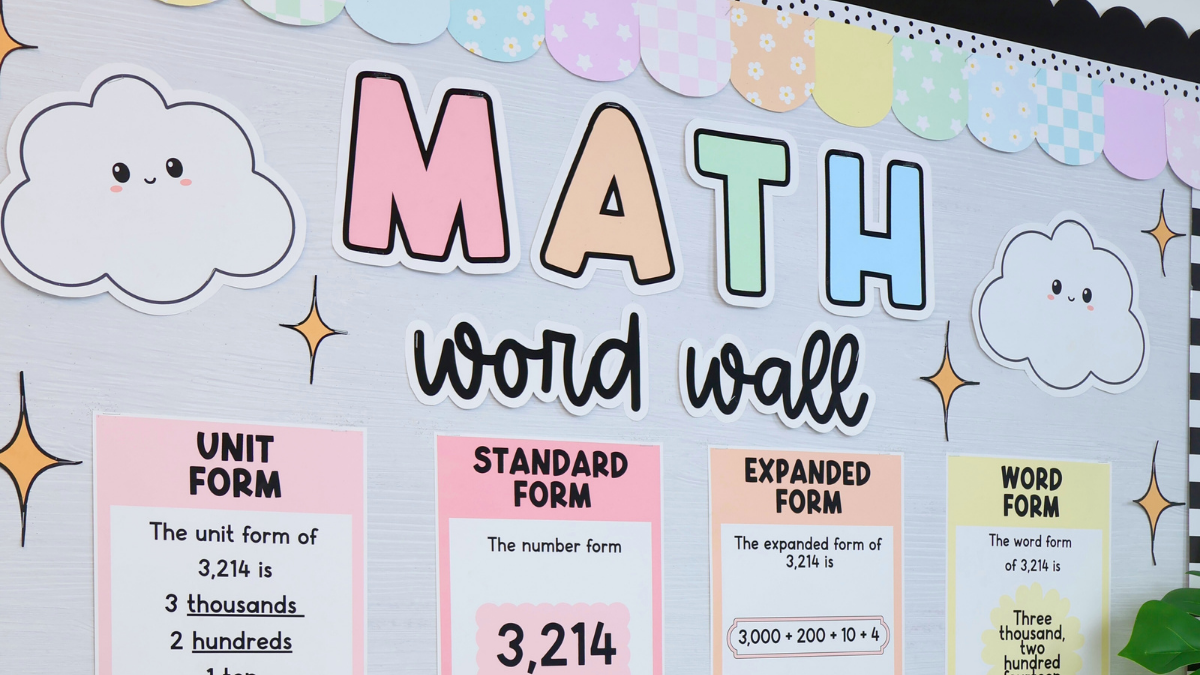
1. I Put Up a Module Vocabulary Bulletin Board
When a new module begins, I put up a bulletin board with vocabulary and visuals that relate to the skills we're about to learn.
This becomes our reference wall for the unit.
It gives students a preview of the language they'll be seeing and helps them start making connections right away.
2. We Do a Gallery Walk
Before I teach the unit, students do a quick gallery walk and look at the vocabulary cards/posters.
Their goal is simple: Look closely and try to remember as much as you can.
This gets them engaged right away and builds curiosity about what we're about to learn.
3. We Play a Team Game or Class Competition
After the gallery walk, we usually play some kind of team-based game to see what students remember.
It's low pressure, fun, and collaborative—more of an "intro challenge" than a quiz.
Sometimes we use a classroom team competition, and sometimes students play a review game (like Blooket) to help reinforce the new terms.
This part is huge because students are:
- Seeing the vocabulary
- Hearing it
- Saying it
- Using it in a meaningful context
That combination helps it stick.

4. We Use the Vocabulary All Unit Long
Once the module starts, I keep referring back to the vocabulary during:
- Whole group lessons
- Small group instruction
- Partner work
- Independent work
If students ask questions, I'll often point them back to the vocabulary board and use the exact term in my explanation.
This helps students connect the word to the concept over and over again (instead of hearing it once and forgetting it).
5. Students Start Using It Independently
This is one of my favorite parts.
Over time, students begin using the vocabulary on their own during math discussions and while explaining their thinking. They also start checking the board independently when they're unsure about a word in a question.
I've noticed this really helps with:
- Student confidence
- Classroom efficiency
- Student independence
- Reducing repeated "what does this mean?" questions
It also frees me up to spend more time with students who need extra support, because other students can use the resources around the room to keep going.

Why This Helps With Testing
Pre-teaching vocabulary is helpful for everyday instruction and for testing.
Standardized test questions are often written in ways that are different from how students usually see problems in class. Even when students know the skill, the wording can trip them up.
When students are familiar with math vocabulary, they are more likely to:
- Understand what the question is asking
- Recognize the skill being assessed
- Avoid confusion caused by wording
- Feel calmer and more confident during testing
And while school is about more than tests, test-taking skills are still important life skills.
Students will be asked to show what they know in many settings over time—whether that's in school, college, certifications, or eventually interviews and job-related situations. Helping students build vocabulary, confidence, and clarity now supports them far beyond one test day.
What I've Noticed in My Classroom
Since making vocabulary a bigger part of how I introduce a module, I've noticed that students:
- Participate more in math discussions
- Explain their thinking more clearly
- Rely less on me for repeated clarification
- Use classroom resources more independently
- Feel more confident when they see unfamiliar question wording
Even students who already understand the math often use the vocabulary board as a quick confidence check—and that matters.
Sometimes they just need to confirm, "Am I understanding this question the right way?"
Having a visual reference available helps them move forward.
Simple Ways to Start
You don't need a huge setup to start. Here are a few easy ways to begin:
Getting Started
- Introduce 3–5 key words before a new lesson or unit
- Keep vocabulary visible during instruction
- Use a quick gallery walk or partner talk
- Play a low-stakes review game to reinforce terms
- Refer back to the vocabulary during independent work
The goal isn't to frontload everything at once—it's to give students just enough language support so they can access the learning.
Quick Recap
Pre-teaching vocabulary helps students:
- Understand math concepts more deeply
- Talk about math more clearly
- Become more independent
- Feel more confident
- Handle different question formats more successfully
It's one of those strategies that supports both understanding and efficiency in the classroom.
Math Vocabulary Poster Resources
Before buying or making anything extra, it's worth checking whether your math curriculum already includes vocabulary cards or posters for each module.
Some curriculums do provide vocabulary supports—but many don't (or they're limited, hard to display, or not easy for students to reference consistently).
My curriculum didn't include ready-to-use math vocabulary posters in a way that worked for my classroom, so I made my own.
If your curriculum already has a strong vocabulary component, that's great—use it. If not, having a consistent set of vocabulary posters can make a big difference.
Shopping Tip
Compare the vocabulary/topics in your curriculum modules to any poster set you're considering so you can make sure it matches what you actually teach. Most grade-level math vocabulary is pretty standard, but it's always a good idea to double-check.
Available Resources:
- 2nd Grade Math Vocabulary Posters (BOHO)
- 3rd Grade Math Vocabulary Posters (BOHO | Brights)
- 4th Grade Math Vocabulary Posters (BOHO | Brights)
- 5th Grade Math Vocabulary Posters (BOHO | Brights)
Teacher Note
I love anything that makes students more independent and helps me stop repeating myself all day. Pre-teaching vocabulary has definitely done both.